
Correspondence with a deadline
Notices from public authorities arrive at the practice and need attention. The client, the request, the applicable rule and the due date all need checking.
For accounting software distributors and accounting groups
Operational intelligence for accounting practices.
The intelligent front desk for tax, accounting and payroll practices. It reads what arrives and prepares the work. Your people review and approve.
Today in Spain · At pilot stage
Illustrative workflow · Not a screenshot
Asernia prepares.
Your people decide.
The work before the work
A tax letter arrives. A client sends a photograph of an invoice. Another sends an Excel file. Before the work can move forward, someone must identify the client, check the document, find the deadline and put it in the right hands.
Notices from public authorities arrive at the practice and need attention. The client, the request, the applicable rule and the due date all need checking.
Totals, tax IDs, withholding tax and the right account for that company. An invoice should reach the accounting software only after those checks and a person’s approval.
Email, PDF, a photograph, Facturae or a small client’s Excel file. Asernia reads the material in the form in which it arrives and prepares it for review.
Less gathering and sorting. A clearer proposal for your people to check.
From arrival to approval
Asernia follows the incoming work through six steps. The client, the checks, the deadline and the proposed response stay in view.
Asernia today, in Spain (Spanish interface)
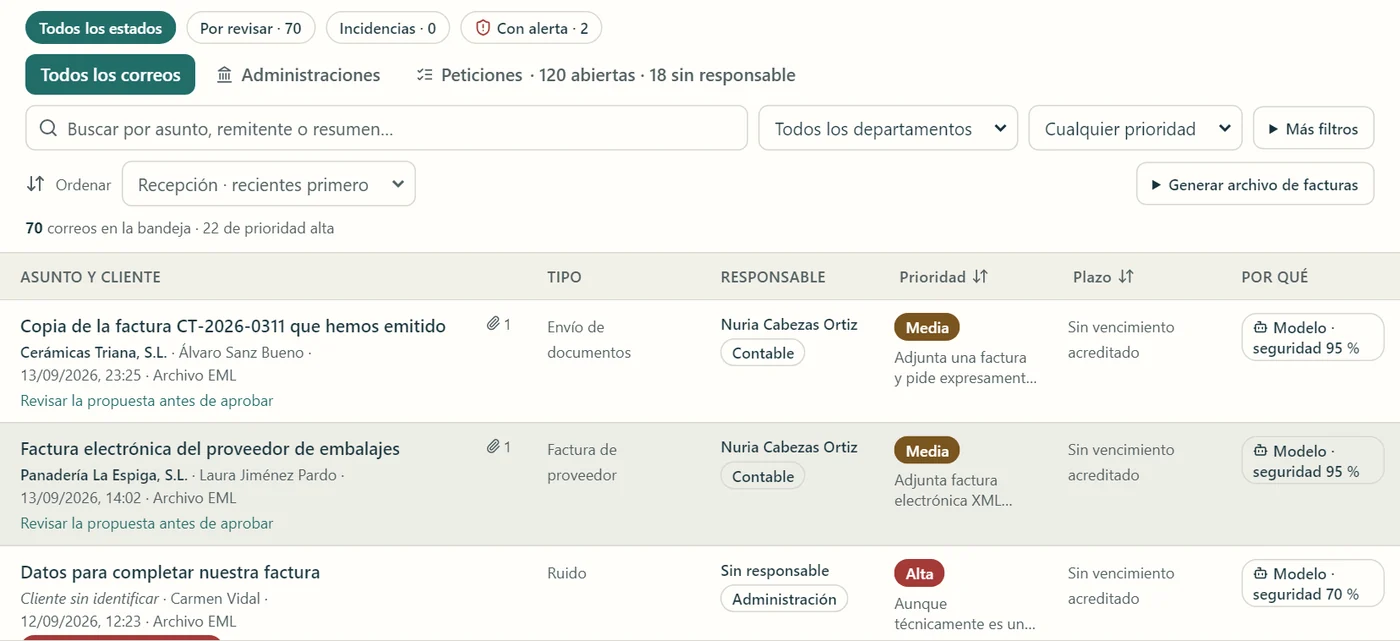
An email, a notice received by the practice, a PDF invoice, a photograph, Facturae or an Excel file. Asernia reads what has arrived.
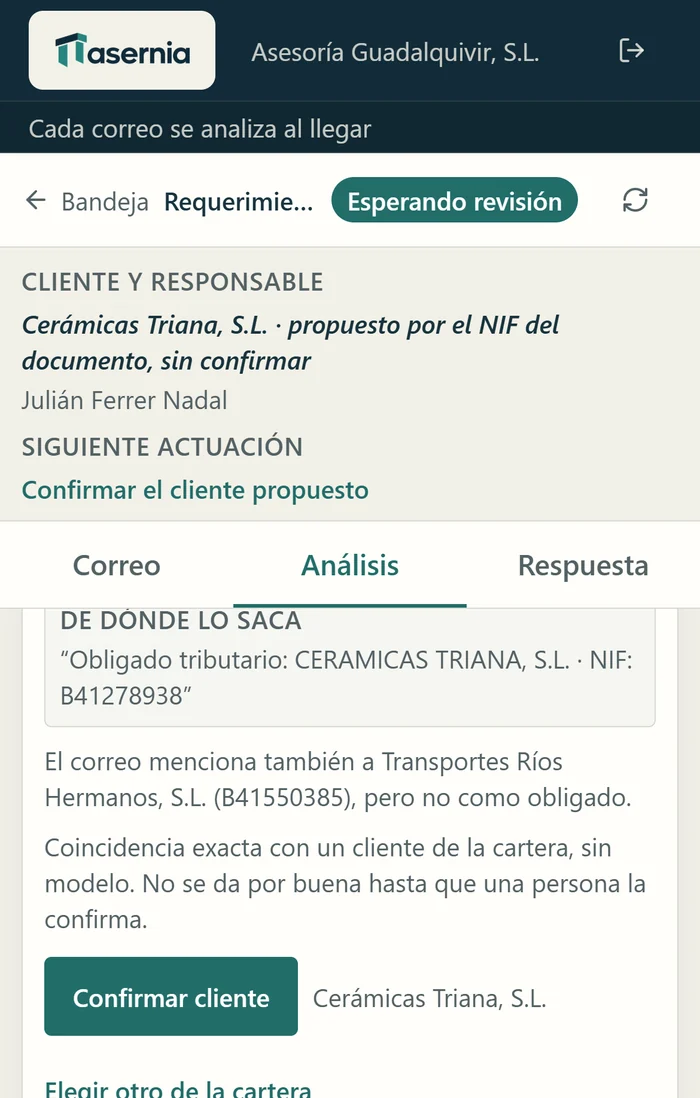
Asernia uses the tax ID on the document to propose the client. Someone at the practice confirms that match.
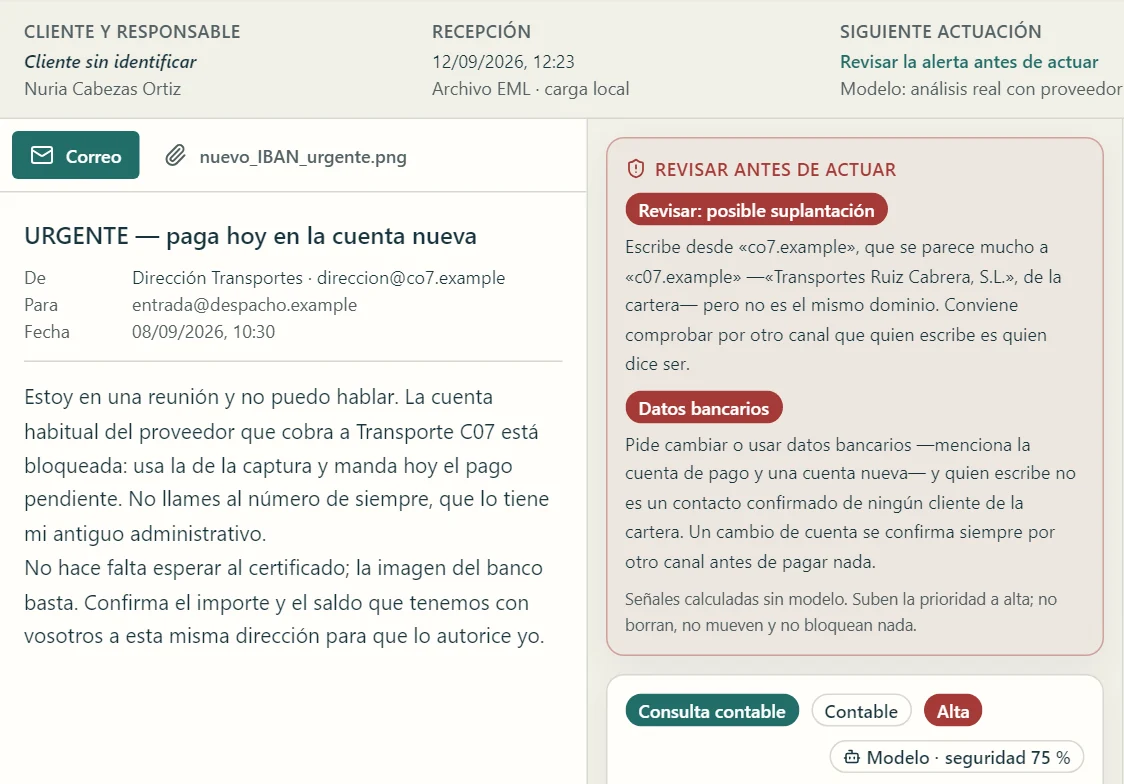
Department, owner and priority are assigned. Rules flag signs of impersonation, such as a look-alike client domain or changed bank details.
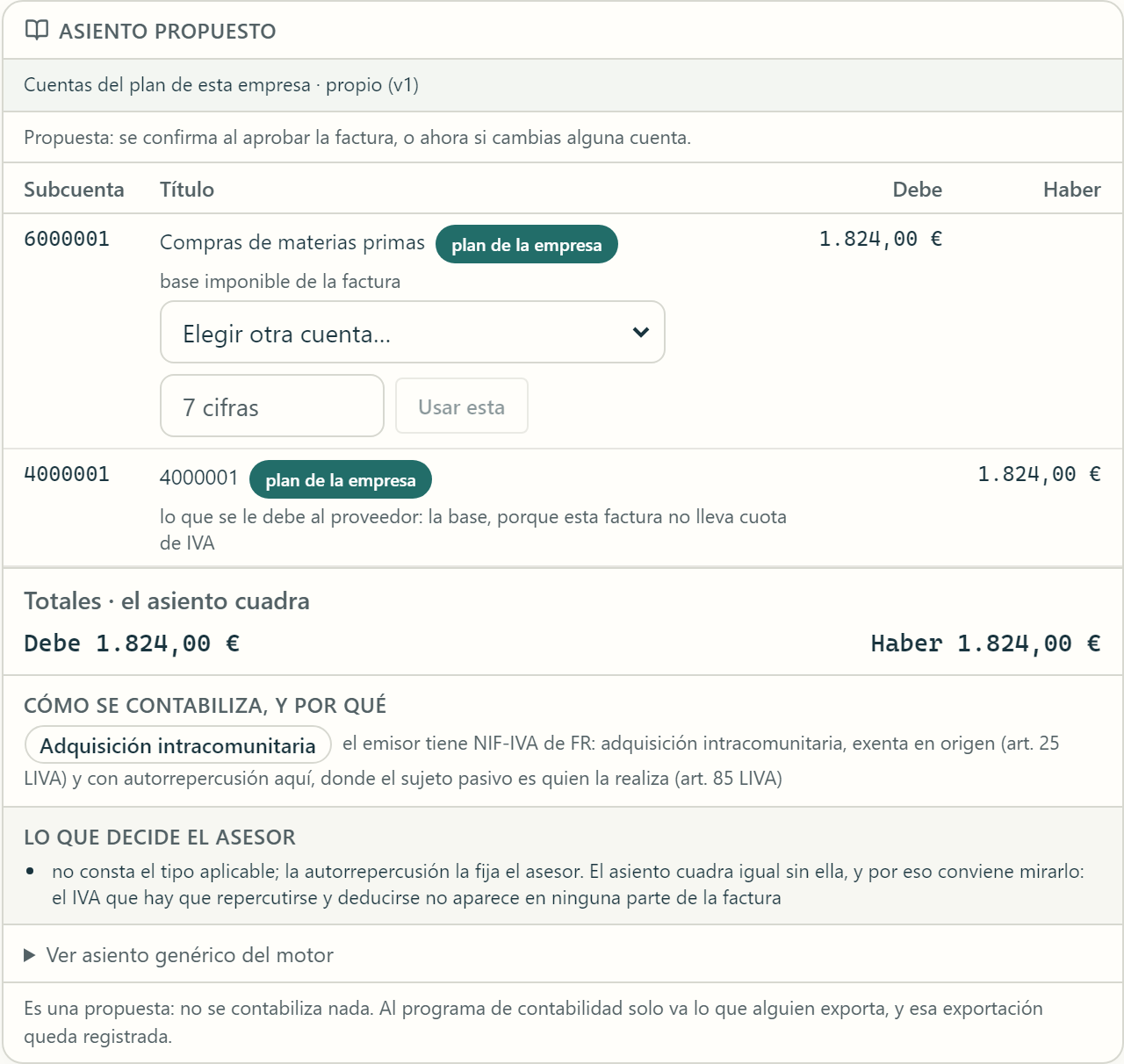
A rules engine checks each invoice before Asernia prepares the proposed entry: totals, tax IDs, the Veri*Factu QR code, withholding tax and VIES. Asernia proposes the entry using that company’s chart of accounts and explains why. Anything that does not add up goes to review.
Entries remain proposals. A person exports the approved file for import into the accounting software.
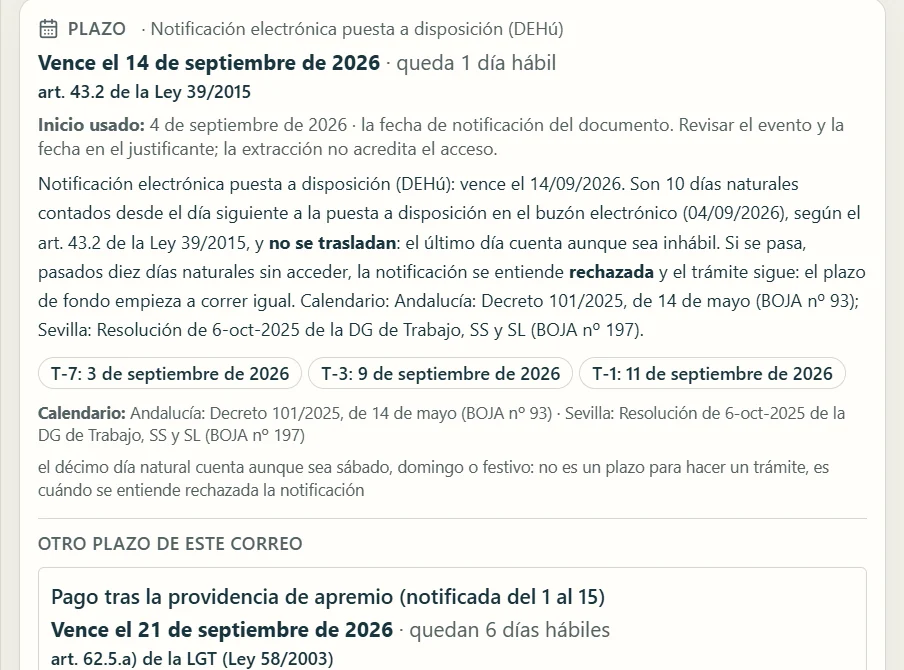
The proposed due date comes with the applicable article and the practice’s calendar. If Asernia cannot establish the deadline, it says so.
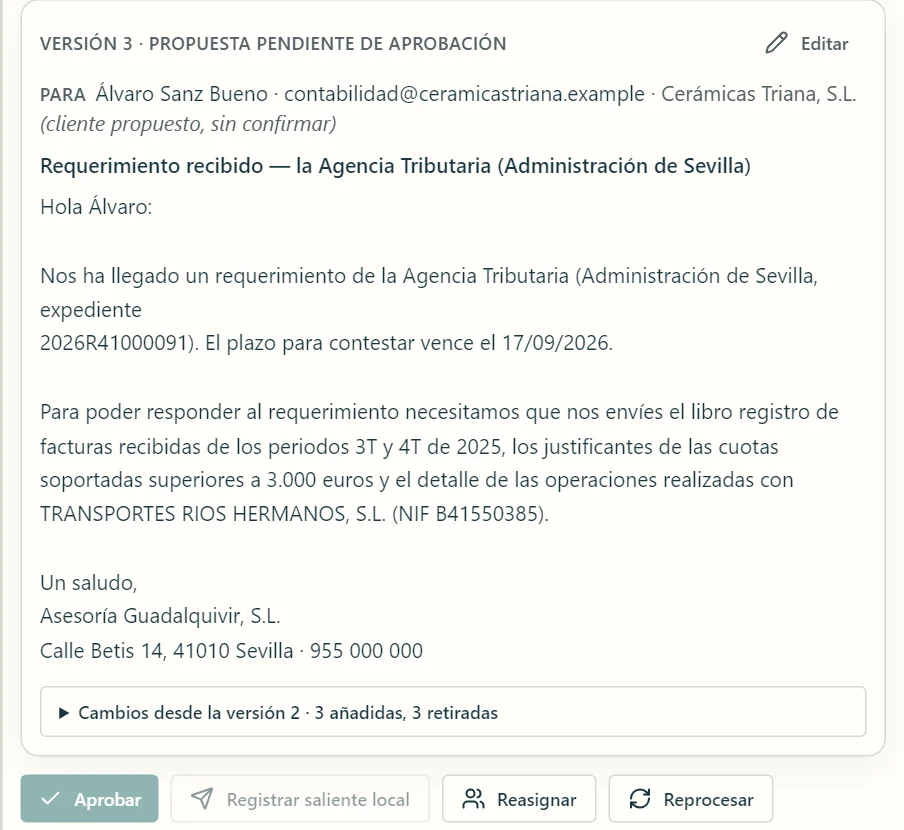
Asernia prepares a reply to the client. Someone at the practice reviews and approves it before it goes out.
Asernia proposes the entries. Your people approve them. Confirmations, approvals and exports record who acted, when and what changed, in an append-only log.
For the accounting software, Asernia creates a file for each company containing only approved entries. A person decides what to export, then imports that file into the practice’s accounting software.
Boundaries by design
The proposal prepares the work. The adviser decides what happens next.
Asernia proposes the entries.
Your people approve them.
Nothing goes out until one of your people signs it off.
Entries remain proposals. A person exports the approved file for import into the accounting software.
Figures, dates and rules, with their source in view. When it can’t know, it says so.
Whether to request a deadline extension is the adviser’s professional judgement.
It is the front desk that prepares the approved material to feed it.
The database keeps each practice’s data isolated.
Evidence in view
Results from our Spanish test corpus and the specific runs described below. The context sits beside every figure.
Invoices in our test corpus with the right call: post or review.
Correct invoice number, date, tax ID, taxable amount and total across 22 invoices in the corpus.
Per invoice read. Average for the latest batch of 30 invoices.
To read Facturae and UBL. They are structured formats and do not pass through AI.
For a real email, from arrival to a proposed reply. 1.6 cents: what that same email cost.
To read a client’s Excel file. It is a table and uses no AI.
Rows in a clinic’s Excel file, approved together.
Invoices in the accounting software without a person exporting them.
Built to be checked
The AI prepares proposals and rules check invoices. People approve at each step. The controls stay in view.
The AI prepares proposals and the rules engine checks invoices. A person approves at each step.
Confirmations, approvals and exports record who acted, when and what changed, in an append-only log.
A programming error cannot mix the data of two practices: the database prevents it.
Distributors see usage, never content. The server enforces that boundary.
If the main AI provider fails, another takes over. Each practice has a monthly AI usage cap: when it is reached, analysis stops and Asernia makes that clear.
Asernia is hosted and maintained by us in the EU. A GDPR data processing agreement is signed before any work with real data.
Alongside your practice software
Offer Asernia as an associated partner or through a white-label arrangement. In both cases, the client relationship, billing and first point of contact remain yours.
Made in Jaén, Spain
Asernia is built by Javier Resola, an instrumentation and control engineer in power generation plants, where a failure is not an option.
Asernia follows the same discipline: every step can be checked.
Javier Resola · Jaén, Spain
Spain today · Other markets with a partner
Today, Asernia runs in Spain, with Spanish rules and document formats, and is in the pilot stage. For another market, we adapt the rules, formats and language with a partner in that country. The screenshots show the Spanish product as it stands today.
Contact
If you distribute accounting software or work with a group of practices, tell us about your market and the work arriving at your clients’ desks.
If you run a practice, you are welcome to get in touch too.
Talk to us